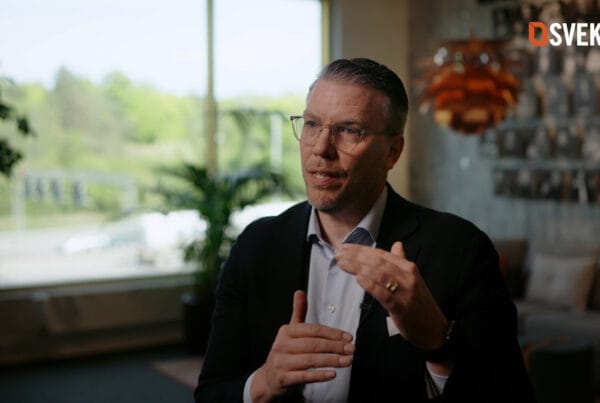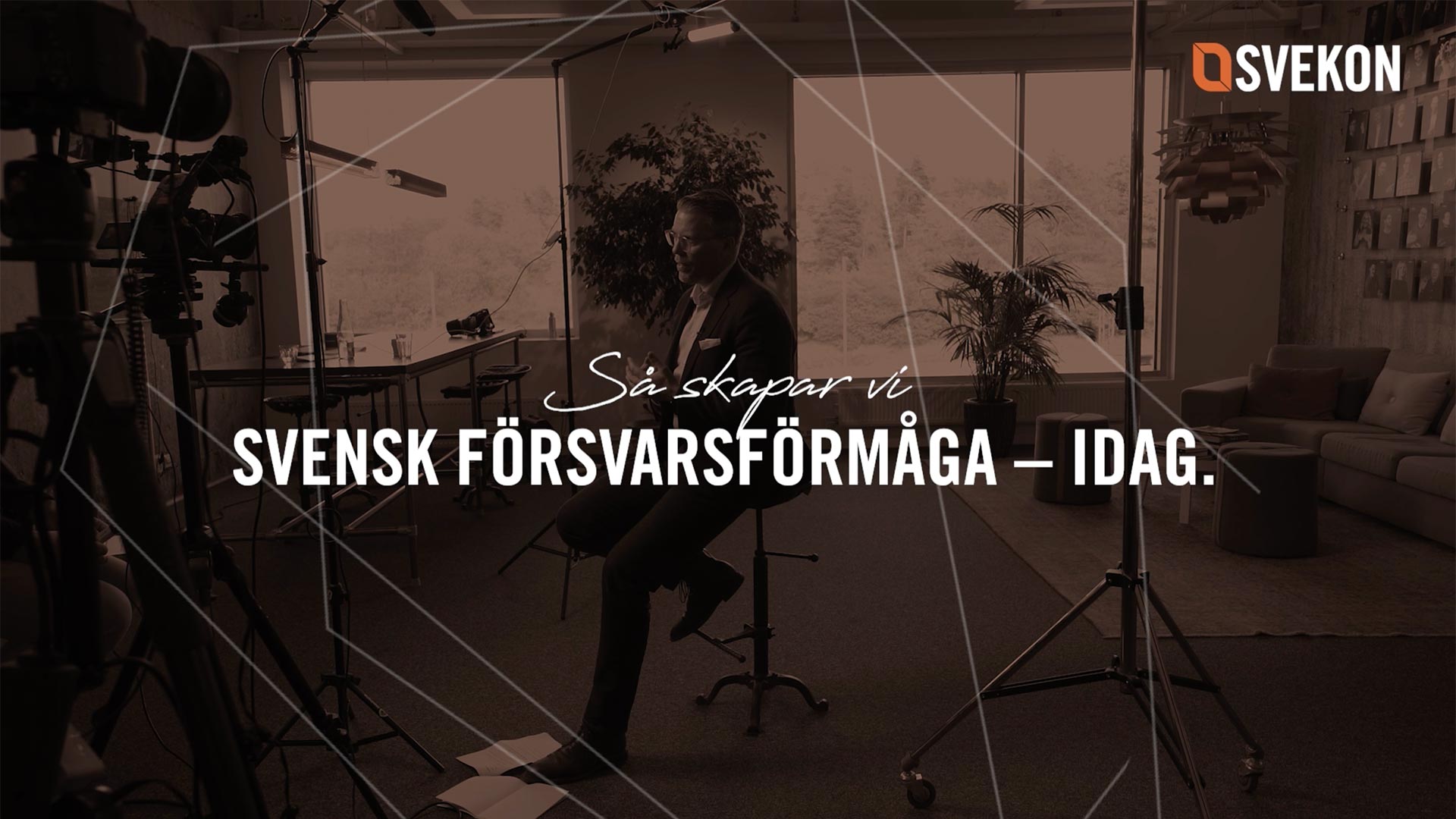
Hear from Svekon’s Deputy CEO, Martin Frisk, as he explains how Svekon works to efficiently build Sweden’s defence capability.
Part 2, 20 October 2026
The fastest way to build new defence capability is rarely to start from scratch. At a time when demand is high and time is limited, Sweden needs to make use of what already works, adapt it to Swedish requirements and turn it into delivered capability.
For us at Svekon, building capability rapidly in Sweden is about precisely this: combining proven technology, engineering expertise, a practical understanding of end-user needs and the industrial capacity to deliver. By building on existing solutions and developing them together with the right partners, both lead times and risks can be reduced. Without compromising on functionality, quality or operational effectiveness.
An approach built on experience
Svekon’s approach is built on experience. We have worked on civilian projects since 1972 and military projects since 1981. Our strength lies in combining experience from civilian industry with a long-standing partnership with the Swedish Defence Materiel Administration (FMV).
Experience from both sectors provides confidence and creates opportunities. It gives us a broad understanding of how to turn ideas into fully functional solutions, both in commercial environments and in contexts where the demands for robustness, reliability and usability are particularly high.
Our civilian experience brings speed, efficiency and expertise in developing solutions that can be manufactured, scaled up and further developed. Our long-standing collaboration with FMV provides a deep understanding of requirements, processes, security, resistance to environmental conditions, operational needs and long-term sustainability..
For us, this is an essential part of what it takes to build capability rapidly in Sweden: the ability to work across industries, leverage existing capacity and turn it into solutions that meet the requirements of the Swedish defence sector.
With our roots as an engineering consultancy and extensive experience in development projects, Svekon has long worked closely with concept development, engineering and technical problem-solving. Today, our capabilities have been further strengthened by our own production facilities in Sweden. This enables us to take responsibility for the entire process – from identifying needs and adapting solutions to integration, production and final delivery.
Turning proven solutions into operational capability
In many development projects, there is an ambition to create something entirely new from scratch. In today’s security environment, this is rarely the most effective approach.
At Svekon, we often see greater value in starting with something that already works. This could be a proven technical solution, a civilian platform, an existing production method or a component that has already been tested and verified.
An important part of accelerating delivery is therefore making use of existing capacity, including resources outside the traditional defence industry. Civilian platforms, established production processes and existing industrial expertise can provide a strong foundation for new defence solutions, provided they are adapted appropriately. However, a solution that works in one context will not automatically work in another. To become operationally relevant, it must be adapted to Swedish military needs, requirements and operating environments. It is often through this adaptation that the greatest value is created.
This may involve:
- Integrating the solution into existing systems
- Adapting it to Swedish operating environments and requirements
- Ensuring it meets the practical needs of end users
- Making the solution suitable for production, maintenance and further development
- Considering robustness, safety, security and long-term use
By building on proven technology and adapting it through targeted development, uncertainty in projects can be reduced. Development efforts can then focus on what truly creates value: adapting the solution to the task, the end user and the environment in which it will be used.
This also enables more organisations to contribute to Sweden’s security of supply. By using existing production capacity, civilian platforms and industrial expertise as a foundation, deliveries can be accelerated, development risks reduced and pressure on traditional defence suppliers eased.
“Building capability rapidly is not about taking shortcuts. It is about making use of what already works, adapting it intelligently and ensuring that the solution can actually be delivered and used in practice.”
Martin Frisk, Deputy CEO, Svekon
For Svekon, this is an area where our experience across both civilian and defence sectors is particularly valuable. We understand how civilian solutions are developed, manufactured and optimised, as well as what it takes to make them relevant in a Swedish defence context.
Above all, it enables us to deliver faster.
It is not about moving away from innovation. It is about applying innovation where it adds the most value, rather than spending time developing solutions that already exist, work effectively and can be adapted.
The end-user perspective as part of development
A solution does not become operationally relevant simply because it works from a technical standpoint. It must work for the end user, in the intended environment, under the right conditions and over time. This is why the end-user perspective is central to Svekon’s approach.
Many of our employees have worked, or continue to work, in roles within Sweden’s defence sector. This gives us a first-hand understanding of what the equipment needs to withstand, how it will be used and the requirements that often only become apparent when a solution is put into practice. It influences the questions we ask, how we interpret needs and how we design solutions.
For us, it is about staying close to operational realities. Understanding the end user’s situation. Recognising the difference between a solution that works on paper and one that works in the field.
Just like our experience across both civilian and military sectors, the end-user perspective provides confidence throughout the entire process, from development to delivery.
“Our strength lies in combining experience from civilian industry, long-standing collaboration with FMV and employees who have a first-hand understanding of the end user’s operational realities. This enables us to shorten the path from identified need to operational effect.”
Martin Frisk, Deputy CEO, Svekon
Collaboration accelerates delivery
Speed is not achieved in isolation. It requires multiple stakeholders working together towards a shared goal. Collaboration also improves the quality of execution.
To shorten lead times and accelerate delivery:
- The Swedish Armed Forces must contribute operational needs, experience and end-user perspectives
- FMV must establish clear frameworks, requirements and processes
- Industry must translate these into effective solutions
- Partners must contribute specialist expertise, production capacity and scalability
When these elements come together around a shared goal, both the pace and quality of execution improve.
For us at Svekon, it is not about the traditional customer-supplier relationship. It is about working as one team, bringing together responsibility, expertise and the ability to deliver from an early stage. The earlier development, production and end-user perspectives are brought together, the greater the opportunity to shorten lead times and reduce the risk of rework.
“When the Swedish Armed Forces, FMV, industry and partners work towards a shared goal, we can shorten lead times without compromising on quality. It is through the interaction between operational needs, development and delivery that real capability is created.”
Martin Frisk, Deputy CEO, Svekon
Evolving from development partner to full-service provider
For many years, Svekon has been an engineering consultancy with extensive expertise in development, engineering, integration and technical projects. This remains a central part of our identity.
But as the needs of Sweden’s defence sector have evolved, so has our role.
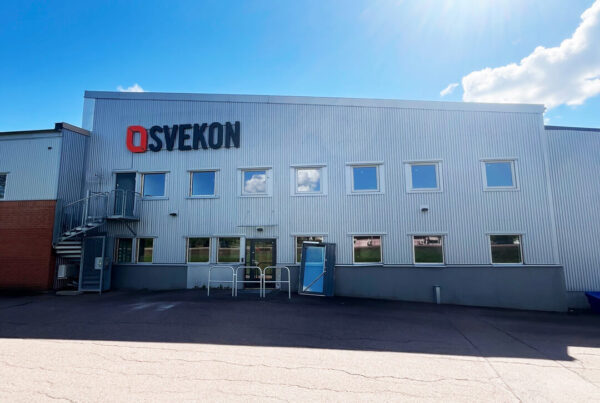
To help shorten lead times and strengthen Sweden’s ability to deliver, Svekon has expanded its operations with its own production capacity in Sweden. This allows us to bring development, integration, production and final assembly closer together. It changes the scope of what we can take responsibility for.
When development and production are closely connected from an early stage, solutions can move more quickly from concept and adaptation to a fully functional product. This reduces the risk of gaps between engineering and delivery, while making it easier to test, adjust and improve solutions throughout an iterative development process.
For Svekon, this is a natural progression. Our background as an engineering consultancy gives us a deep understanding of technology, requirements and the development process. Our own production capacity also enables us to take greater responsibility for execution.
This strengthens our role as an end-to-end solutions provider: from identifying needs and development through to integration, production and delivered capability.
“As the needs of the defence industry grow, developing technical solutions alone is no longer enough. You also need the capacity to produce and deliver them. For Svekon, the transition from engineering consultancy to having our own production capabilities has been about precisely that: taking greater responsibility, delivering faster and maintaining that commitment over the long term.”
Martin Frisk, Deputy CEO, Svekon
Svekon’s role: Shortening the path to operational effect
At Svekon, we work on the principle that capability can be built rapidly by building on what already works, adapting it to the right context and delivering solutions together with partners whose expertise complements our own.
We believe in proven solutions, but also in targeted development. We believe in speed, but not shortcuts. We believe in collaboration, but also in clear accountability.
With experience in civilian projects since 1972, collaboration with FMV since 1981 and our roots as an engineering consultancy, we have developed a deep understanding of what it takes to turn an idea into a fully functional solution. Now, with our own production capacity in Sweden, we can take greater responsibility for the entire process, from identifying a need to delivering operational capability.
This builds confidence. It reduces risk. And it enables us to deliver relevant capability in the near term.
In this context, creating a better tomorrow means taking responsibility for what needs to work here and now, and doing so together.